
HR & Payroll Software in Pakistan: What to Look For in 2026
The modules, Pakistani compliance points (salary tax, EOBI, social security) and questions to ask before you buy or build HR and payroll software.

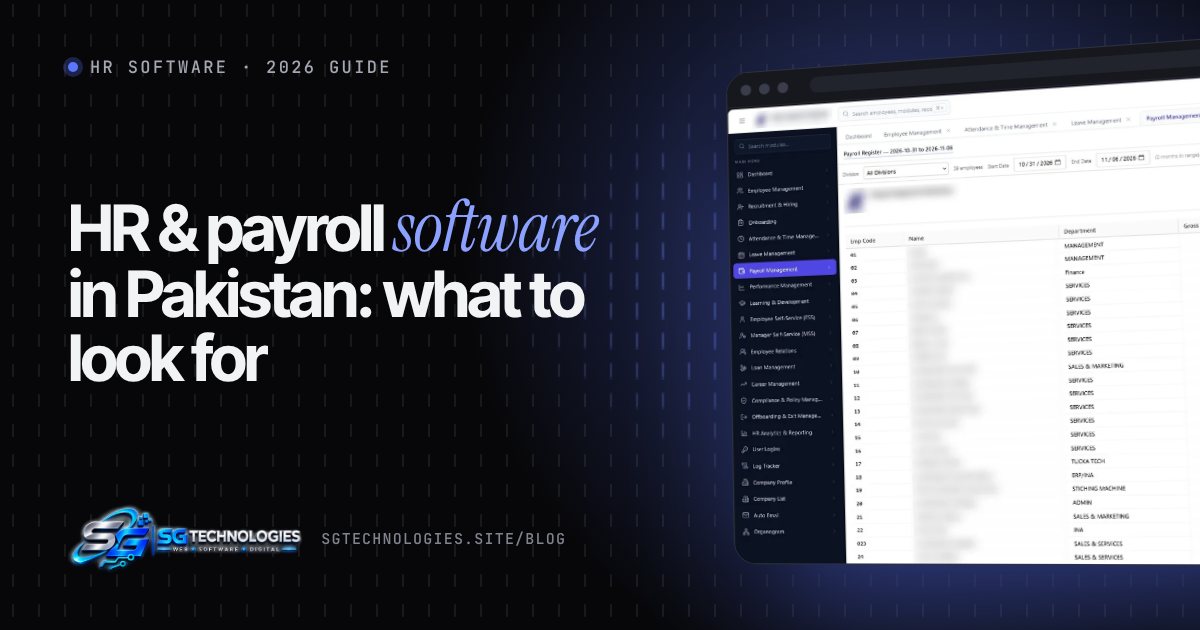
Quick answer: Good HR and payroll software for a Pakistani company should cover the whole employee lifecycle — hiring, onboarding, attendance, leave, payroll, loans, performance and exit — in one system, and handle local compliance such as income tax deducted from salaries, EOBI and provincial social security contributions. Choose off-the-shelf software if your processes are standard; choose a custom system if you have multiple companies, shifts, factories or approval rules that generic tools can't follow.
Most growing companies in Pakistan start with Excel sheets and a biometric attendance machine. It works — until you reach a few dozen employees, several departments or more than one company. Then payroll takes days, leave balances are disputed, and nobody trusts the numbers.
This guide explains what to look for, based on our experience building a complete HR management system for an apparel manufacturer.
Signs you have outgrown spreadsheets
- Payroll takes more than a day to prepare and still needs manual corrections.
- Leave balances and late arrivals are calculated by hand and often disputed.
- Loans and salary advances are tracked in a separate sheet — and deductions get missed.
- Managers can't approve leave or see their team's attendance without asking HR.
- You can't answer simple questions quickly: How many people did we hire this year? What is our attendance rate?
- Employee data is spread across files, WhatsApp chats and email.
The modules a complete HR system needs
| Module | What it should do |
|---|---|
| Employee management | One record per employee: personal details, department, designation, documents, organogram |
| Recruitment & onboarding | Open positions, candidates, offers, and an onboarding checklist for new joiners |
| Attendance & time | Daily attendance, late arrivals, shifts, rest days and integration with biometric devices |
| Leave management | Leave types and balances, requests and approvals, short leave |
| Payroll | Gross salary, allowances, deductions, tax, loans and advances, payroll register and payslips |
| Loans & advances | Loan requests, approval and automatic monthly deductions |
| Performance & learning | Reviews, goals, training records |
| Self-service (ESS/MSS) | Employees view payslips and apply for leave; managers approve and see their team |
| Compliance & policies | Policy documents, acknowledgements, disciplinary and employee-relations records |
| Offboarding & exit | Resignations, clearance, final settlement |
| Analytics & reporting | Headcount, hiring, attendance and payroll reports, exportable to Excel/PDF |
| Security & audit | Role-based access, user logins and an audit log of who changed what |
Pakistan-specific compliance to plan for
Rates and thresholds change every budget, so your software should keep them configurable, not hard-coded. The main areas are:
- Income tax on salaries. Employers withhold tax from salaries under section 149 of the Income Tax Ordinance, 2001 and must use the current year's salary tax slabs. The system should recalculate tax when slabs change in the Finance Act.
- EOBI. Employer and employee contributions to the Employees' Old-Age Benefits Institution for eligible employees.
- Provincial social security. Contributions to the provincial institution — for example PESSI in Punjab or SESSI in Sindh — for covered employees.
- Minimum wage. Set by each province; the system should flag salaries below the current minimum.
- Leave and working hours. Annual, casual and sick leave, overtime and rest days according to the labour laws that apply to your business and province.
- Gratuity or provident fund, where your company provides them.
- Payslips and records that you can produce for audits and labour inspections.
This is a planning checklist, not legal advice — confirm the current rates and obligations for your company with your accountant or legal advisor.
Off-the-shelf vs custom HR software
| Off-the-shelf HRMS | Custom HR system | |
|---|---|---|
| Upfront cost | Lower | Higher |
| Ongoing cost | Monthly per-employee fees | Hosting and support |
| Fits your processes | You adapt to the software | The software follows your rules |
| Multi-company / factories / shifts | Sometimes limited | Built for your structure |
| Pakistani compliance | Varies by vendor | Built in from day one |
| Data ownership | Vendor's platform | Your code, your servers, your data |
| Best for | Small teams with standard policies | Growing or complex organisations |
Questions to ask before you buy or build
- Can it handle all our companies, branches and shifts in one place?
- Does it integrate with our biometric attendance devices?
- Can tax slabs, EOBI and social security rates be updated without a developer?
- Can employees and managers use self-service on their phones?
- Who owns the data, and can we export everything if we leave?
- Is there role-based access and an audit log?
- What does support look like after go-live?
How long does it take to implement?
A focused system covering employees, attendance, leave and payroll can usually go live in phases: core records and attendance first, then leave and payroll, then self-service, performance and analytics. The most important step isn't the software — it's cleaning your employee data and agreeing your policies (leave rules, late-arrival rules, approval chains) before you start.
How SG Technologies can help
We designed and built a full HR management system — dashboard, employee directory, attendance, leave, payroll register, loans, performance, self-service, compliance, offboarding, analytics, multi-company support and audit logs. See the HR management system case study or talk to us about your HR process.
Frequently asked questions
What is the best HR software in Pakistan?
The best HR software is the one that matches your structure and policies. Small teams with standard rules can use an off-the-shelf HRMS; companies with several units, shifts or custom approval rules usually get better results from a custom system built around their processes.
Can HR software calculate income tax on salaries in Pakistan?
Yes. A properly built payroll module applies the current salary tax slabs and withholds tax under section 149 of the Income Tax Ordinance, 2001. The slabs should be configurable so they can be updated after each budget.
Can HR software connect to biometric attendance machines?
Most modern HR systems can import attendance from biometric devices automatically, so attendance, late arrivals and leave feed directly into payroll.
How much does custom HR software cost?
It depends on the modules, number of companies and integrations you need. A phased approach — starting with employees, attendance, leave and payroll — keeps the first phase affordable. Contact us for a fixed, written quote.
Do we own the HR system if it is custom built?
With SG Technologies, yes. The code, hosting accounts and data stay in your name.
Related articles
How Much Does a Business Website Cost in Pakistan? (2026 Guide)
What really decides the price of a business website or web app in Pakistan — pages, design, features, content and hosting — with real package examples and hidden costs to check.
Read article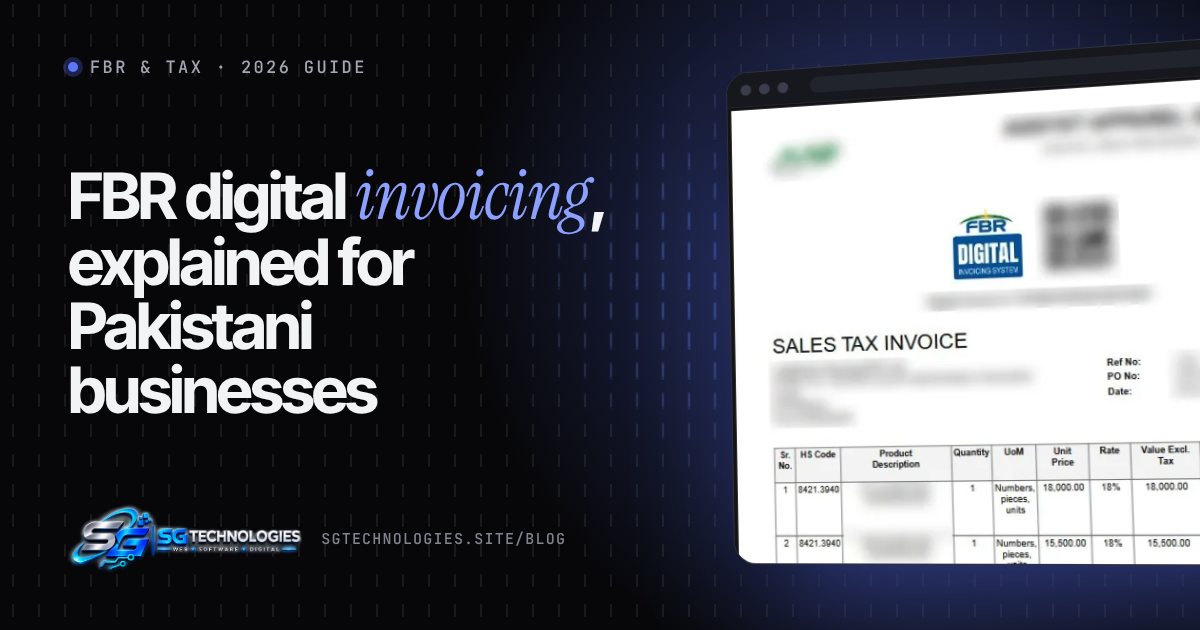
FBR Digital Invoicing in Pakistan: The Complete 2026 Guide for Businesses
Who must integrate with FBR e-invoicing, the deadlines and penalties, how PRAL and licensed integrators work, and what your software needs — explained simply.
Read article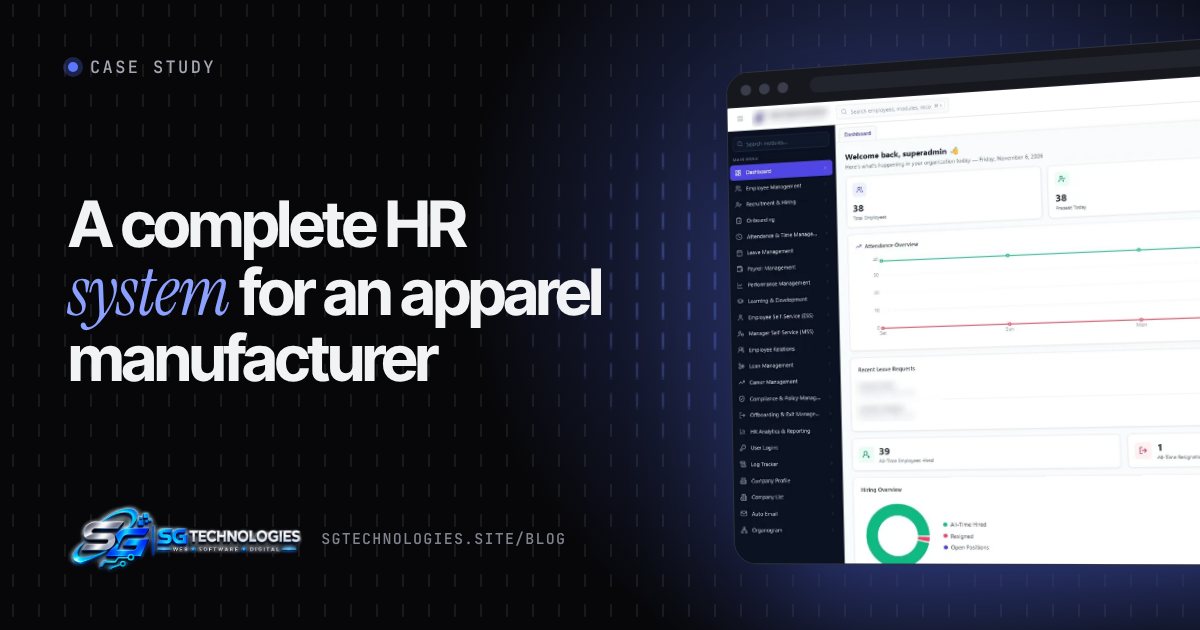
Case Study: Building a Complete HR Management System for an Apparel Manufacturer
How SG Technologies built one HR platform for an apparel manufacturer — attendance, leave, payroll, loans, self-service, analytics and multi-company support.
Read article